Check
It
Out!
|
 |
Pre-trip inspections can
save hassles, time and money — and,
oh yeah, maybe your life.
By Bill Hudgins
September/October 1999 Road
King Magazine
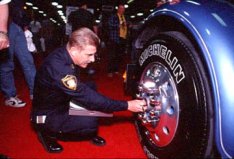
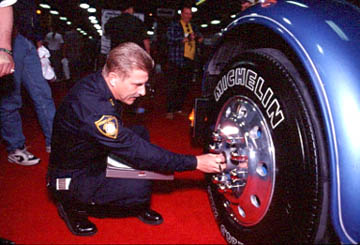
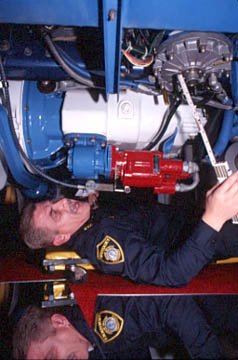
 Greg Hardin, an inspector with Kentucky Motor
Vehicle Enforcement, looks for loose lugnuts
(top) and gets way under the truck to check
‘Ol’ Blue’®, a working
1951 Kenworth, at a safety demonstrations.
Greg Hardin, an inspector with Kentucky Motor
Vehicle Enforcement, looks for loose lugnuts
(top) and gets way under the truck to check
‘Ol’ Blue’®, a working
1951 Kenworth, at a safety demonstrations.
It's the moment every driver
dreads — an officer at a weigh station
has just told you your truck's going to be
inspected. Or maybe you've been pulled over
on the highway for a once-over. Even if everything's
in order, you've still lost time, and that
means lost miles and lost dollars. It doesn't
have to be like this. Truckers could avoid
or at least minimize many of these time consuming,
nail-biting incidents simply by inspecting
their rigs before every trip.
In fact, regulations require
a pre-trip inspection at the start of each
driving day (no matter what the actual time
is). On the back side of each page in the
Driver's Daily Log is a form that drivers
are supposed to complete and sign. Some log
books have a checklist of the items to be
inspected. If your log book doesn't, find
one that does, because without a checklist
you are sure to forget something. Then know
exactly what to look for; the CDL manual covers
all this quite well.
Whether you're an owner/operator
or company driver, making sure your vehicle
is in good working order can save your life.
It's also good defense against a scalehouse
inspection. Burned-out lights, worn tires,
missing mudflaps trigger an officer's suspicion:
If a little thing is wrong, something bigger
could be wrong, too.
That's the message countless
truckers have heard over the years from RJ
Taylor, founder of Ol' Blue, USA (United Safety
Alliance, Inc.). With the cooperation of local
authorities, Ol' Blue, USA demonstrates inspections
at trucking industry events such as the Mid-America
Trucking Show and The Great American Truck
Show.
These exhibitions provide
opportunities for truckers to discuss, and
sometimes debate, inspections and related
matters with officers. It's also a chance
to learn how to find and fix the most common
causes of citations and out-of-service orders.
Ol' Blue, USA also advocates voluntarily having
your rig inspected periodically as additional
insurance against a random going-over, and
against undetected dangers.
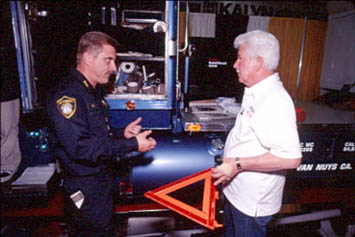
Greg Hardin checks tire condition
and briefs RJ Taylor, owner of ‘Ol’
Blue’, on emergency equipment needs
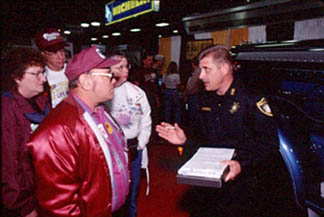
(above). During the Ol’ Blue, USA demonstration
inspection at the 1999 Mid-America Trucking
Show. Hardin fields questions about safety
regs from drivers (below).
|
At the Mid-America Show
in March, Kentucky Motor Vehicle Enforcement
Officer Greg Hardin repeatedly gave ‘Ol'
Blue’ a thorough inspection as show
attendees watched and asked questions. |
"The first thing an
officer looks at is the driver's paperwork,"
Hardin said. This includes logbook, truck
and trailer registration, single state receipts,
bills of lading, medical certificate and ICC
number. "We see many drivers who don't
have the necessary paperwork, or who don't
know what they're required to have, or have
it but it's all over the place. Getting all
their paperwork together causes a significant
number of delays, even if it's all in order,"
he said.
Sloppy paperwork can trigger
a full-blown inspection, on the theory that
the driver or the driver's employer may also
be sloppy about equipment. Hardin outlined
what happens during a "Level 1"
inspection.
The driver usually remains
in the truck, listening for directions from
the officer, and rarely sees what the inspector
is doing. An inspector like Hardin walks around
the truck looking for obvious problems such
as broken lights, loose or missing lugnuts,
worn tires, leaking fluids or air.
The inspector also checks
the horn, windshield and lights. Many drivers
like to decorate their tractors with dozens
of lights, far more than required by law.
They look good at night, but, if they're on
the truck they all have to work, Hardin noted,
not just the minimum equipment.
Hardin then moved on to the
brakes and tires. "On an 18-wheeler,
you have 10 brakes. If two aren't in proper
working order, the officer can place you out
of service," he said. He checked to see
that the brake lights came on when Taylor
pushed the pedal and listened for the telltale
hiss of air that would indicate a leak.
He searched for cracks in
the wheels, oil around seals, leaks, insufficient
tread depth, and cuts and worn spots in the
tires. "If we have any doubts about these
items during this general check, we go further,"
Hardin said.
The officer then crawled
under the tractor and trailer, and gave the
brakes a closer inspection. He was looking
first for rust, "which is a good sign
that the brakes aren't working properly";
for wear in the brake linings and for proper
adjustment.
While under the truck, Hardin
also eyeballed the steering mechanism for
rust, which could indicate it was loose. He
checked the condition of the suspension system,
and looked for kinks or cracks in the air
hoses. He made sure there weren't any cracks
in the frame and that air tanks and other
equipment were securely attached to the frame.
Like oil and grease, air can be a clue, too.
He completed his tour by
checking ‘Ol' Blue’s fire extinguisher
and emergency reflector kit. For his demonstrations,
Taylor will occasionally disconnect a light
or create some other problem so the officer
can elaborate on it. This time, except for
a non-working light, ‘Ol' Blue’
was clean as a whistle.
"If drivers would take
time every day to go around their trucks,
they could significantly reduce the number
of citations and out-of-service orders officers
issue," Hardin said. This would save
time and out-of-pocket costs for service calls
to scalehouses, as well as lost revenues,
he added.
The bottom line on inspections
is more than dollars and cents. "Regular
pre-trip inspections would make trucks safer
to drive for truckers and everyone else,"
he said.
Copyright 1999 Road King
Magazine
|















 is a registered
trademark.
is a registered
trademark.